How thUSD Turns Gold Market Carry Into Dollar-Denominated Yield
·
5
MINUTES
·
By:
Theo
Gold has served as collateral, reserve asset, and settlement instrument for thousands of years.
thUSD brings that foundation onchain and puts it to work.
The design starts with physical gold. Rather than holding that gold idle, the strategy makes it productive through the institutional gold market: leasing physical gold into real commercial demand, hedging the price exposure with CME futures, and posting Treasury collateral to support the position. The result is a dollar-denominated yield drawn from three established markets: the gold lease, the CME futures basis, and U.S. Treasury collateral.
thUSD is designed to be legible to both crypto users and institutional allocators. Its backing, liquidity, yield sources, custody, and risk controls are meant to be clear enough for a treasury team to underwrite.
This piece contains three main parts:
The gold carry strategy and how it works
Why the yield is independent of crypto
The institutional stack and risk controls beneath it
thUSD at a Glance
One distinction sets the stage for the rest of this piece. thUSD is the liquid dollar-denominated asset, backed by cash equivalents and T-bills. sthUSD is the staked version, and staking is how a holder participates in the gold carry strategy described here and receives its yield. When this piece refers to the strategy and the yield, it is describing what sthUSD holders receive. The token mechanics are covered in full in our docs.
sthUSD has delivered ~5.4% APY net of all fees since inception, competitive with the leading yield-bearing stablecoins. The source is a delta-neutral carry trade on physical gold, run through institutions like Wellington Management, Standard Chartered, and CME. Because the return is drawn from gold-market and Treasury activity rather than crypto, it holds across cycles.
Here's how that strategy works.
Part 1: The Strategy
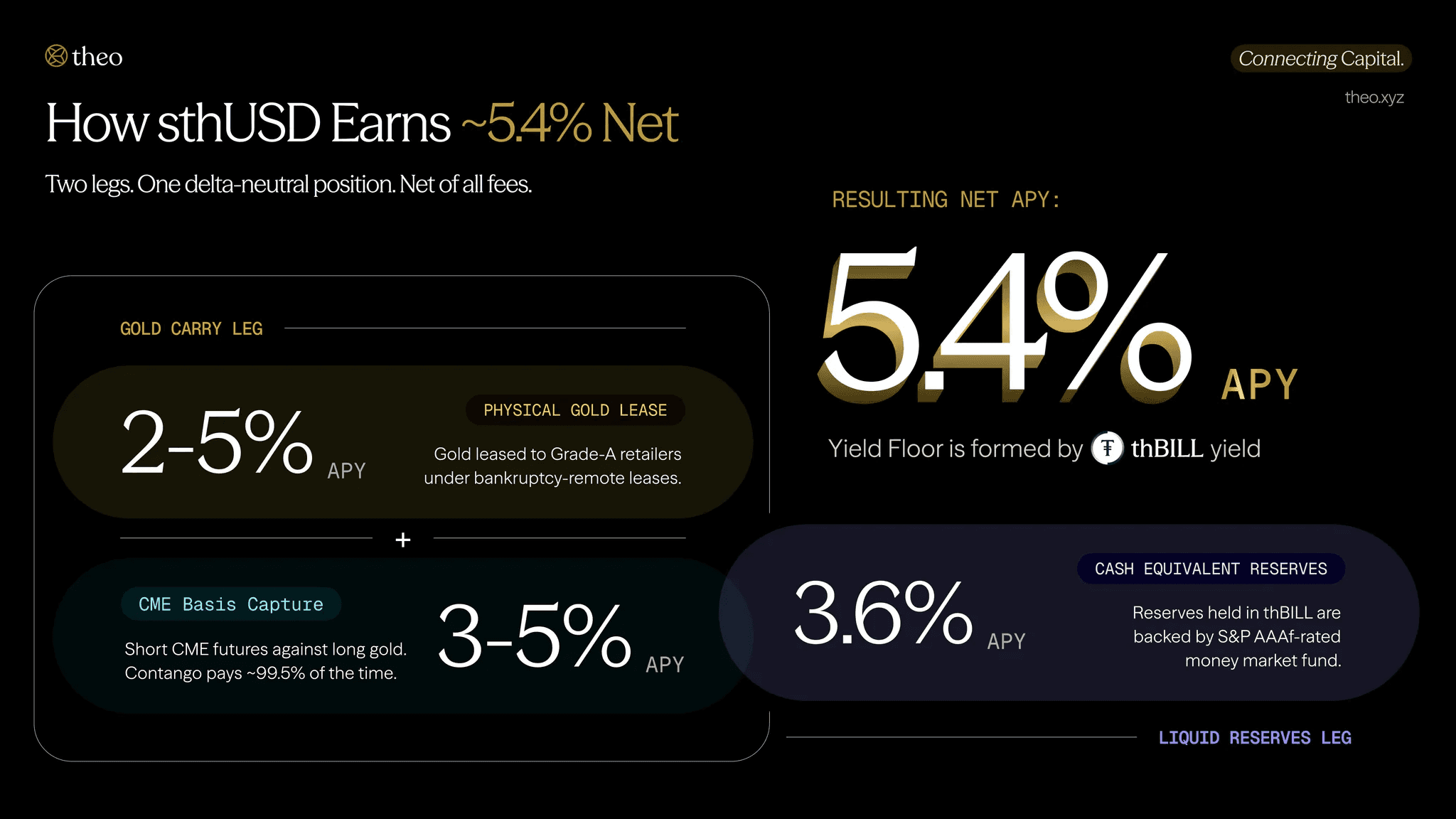
The mechanics of sthUSD are straightforward. sthUSD holds a single delta-neutral position: long physical gold, short an equivalent quantity of CME gold futures, with T-bills posted as margin. That one position produces three independent yield streams. The price exposure on the long and short legs is designed to offset, and what's left is carry.
1a: Three Yield Streams
Yield Stream 1: The Gold Lease
The gold held by the strategy is yield-bearing rather than passive. It is leased to vetted precious-metals businesses (dealers, refiners, jewelers) that need physical inventory, with the return denominated in ounces. These lessees include the MG999 fund, a bankruptcy-remote Singapore fund that makes senior secured loans to gold-sector retailers with principal denominated in grams of gold against the LBMA Gold Price AM, alongside other independent lessees with long operating histories in the physical gold trade.
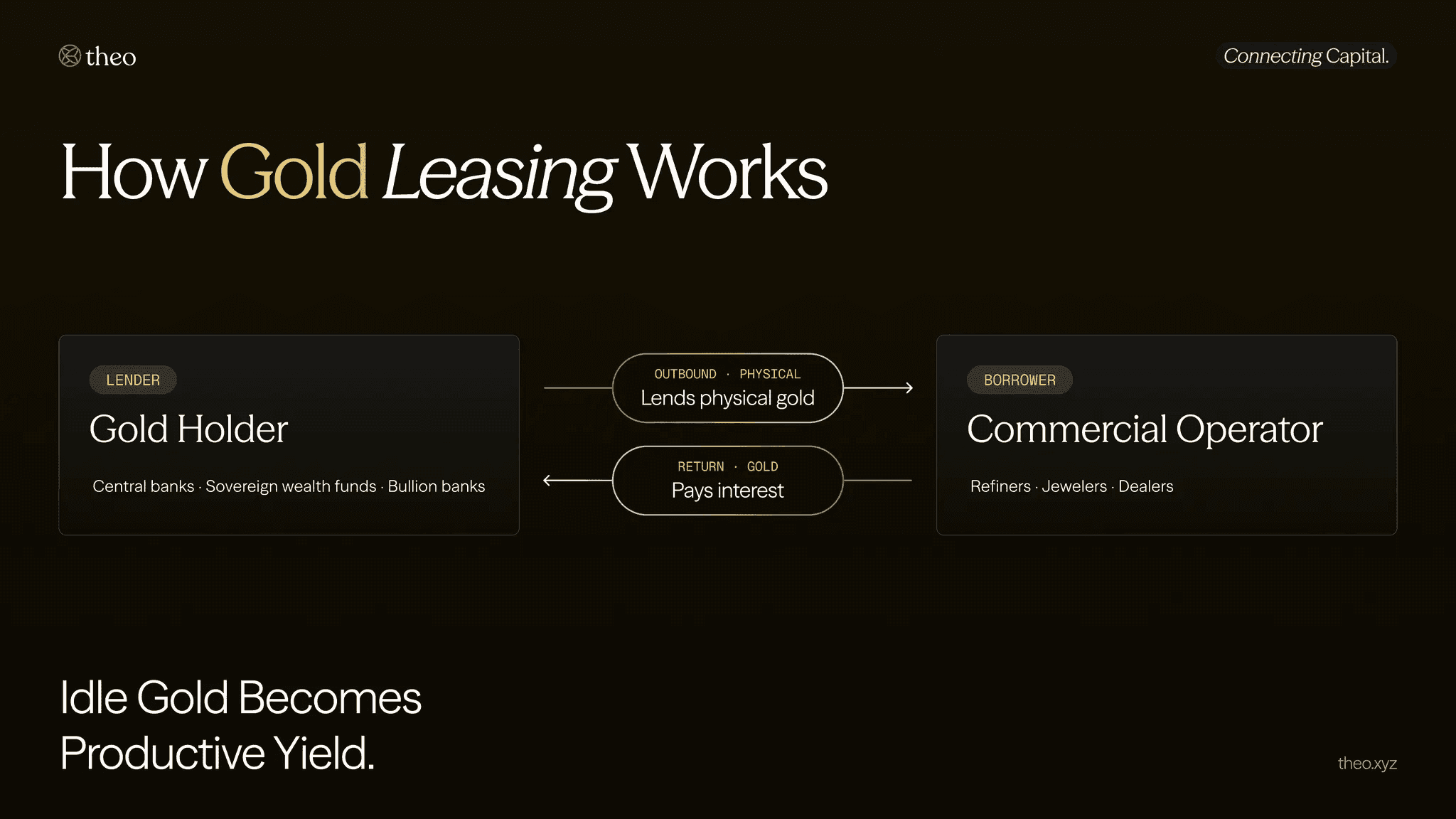
This is what the gold market does every day. Dealers, refiners, and jewelers lease gold rather than buy it outright, because holding inventory carries costs and lease rates are predictable. The lease pays a return denominated in ounces; the borrower returns the same physical gold at the end of the term, plus interest. It is a steady, recurring contribution to the strategy.
The lease return is driven by physical inventory demand from retailers who need gold to sell, which persists across market conditions, and the leased gold is bankruptcy-remote, insured, and secured in the fund's favor, so a borrower failure does not reach sthUSD holders.
Yield Stream 2: Basis Capture on CME Gold Futures
For every ounce of physical gold on the long side, the strategy is short an equivalent quantity of CME gold futures, with the hedge maintained close to 1:1. This serves two purposes.
It is designed to neutralize the gold price exposure. If gold rallies, the long leg gains and the short futures lose. If gold drops, the opposite. The hedge is built to substantially offset price movement in either direction, so sthUSD holders are exposed to the dollar rather than to gold.
It captures the basis. CME gold futures trade in contango roughly 99.5% of the time. Contango means the futures price is higher than spot, reflecting the cost-of-carry on a physical commodity (storage, insurance, financing). As a contract approaches expiry, the futures price converges to spot, and holding the short side of that convergence captures the difference. This basis is the largest of the three contributions to the strategy.
This is a strategy that has run in commodity markets for over a century. Hedge funds, commodity trading houses, and institutional desks have captured the futures basis on gold, silver, oil, and grains for as long as those markets have existed, at the scale of tens of billions of dollars per strategy.
The margin posted on the CME short is custodied at the clearing FCM, a US-regulated, Fortune-500 firm, in CFTC-segregated futures customer funds, not at Theo. Because the position clears through CME Clearing, a CFTC-regulated central counterparty, there is no auto-deleveraging waterfall and no insurance-fund mechanism that can force-close the hedge during stress.
Yield Stream 3: T-Bill Backing
Unstaked thUSD backing is held in short-dated T-bills. These T-bills sit inside thBILL, Theo's tokenized Treasury product, managed by Wellington Management through an S&P AAf/S1+ rated short-duration Treasury fund, custodied at Standard Chartered, and KPMG audited.
All three streams come from real-world markets and run independently of one another.
1b: The Position is Delta-Neutral
Putting the position together: the strategy holds gold (long), shorts CME futures (short), and posts T-bills as yield-bearing margin.
The long and short legs are designed to offset on price. What remains is the gold lease return (from the long side), the basis capture (from the short side), and the T-bill return (on the margin). None of the three depends on the gold price moving in any particular direction.
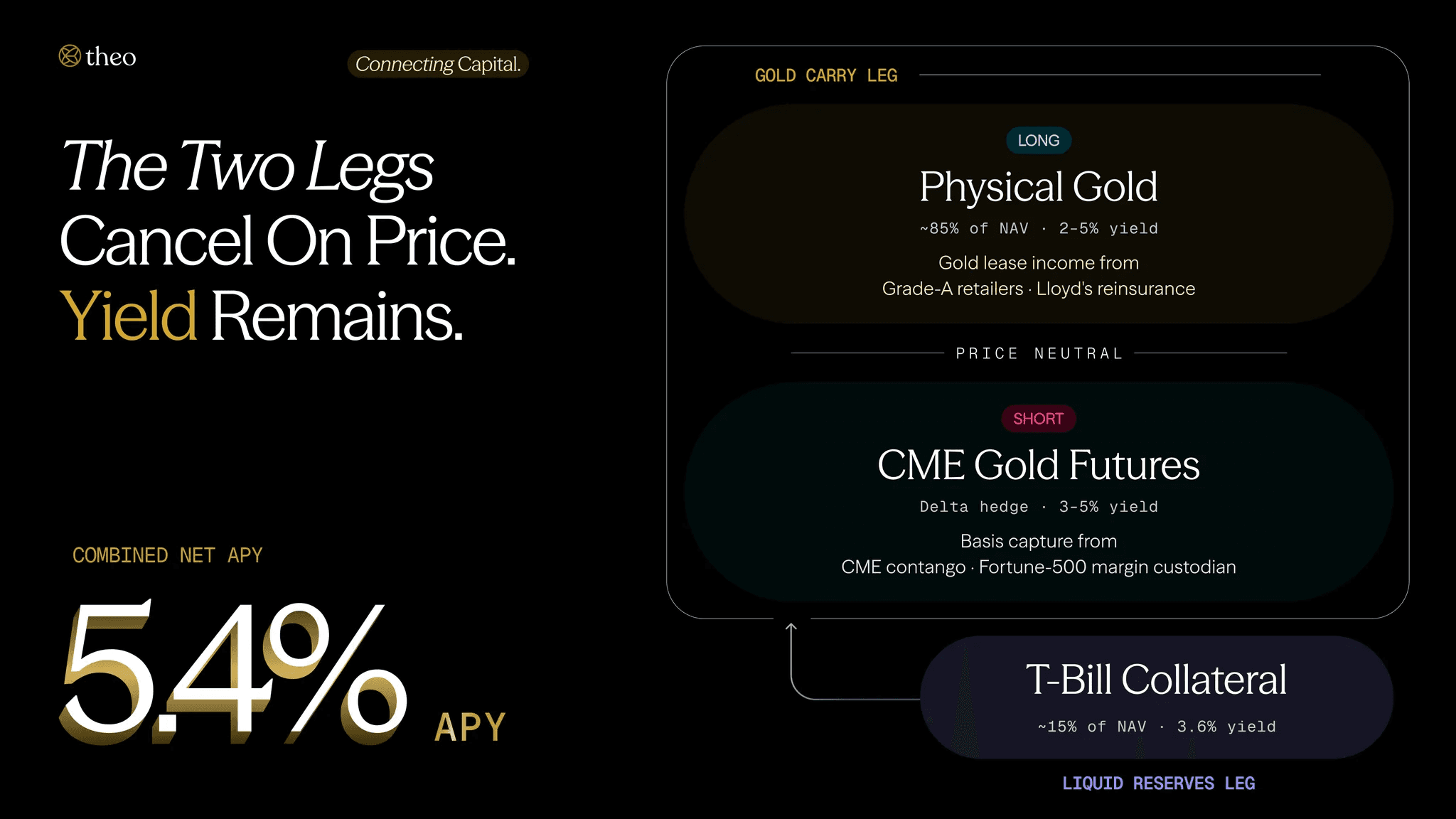
Stakers receive approximately 5.4% APY, net of execution, custody, insurance, and protocol fees. Because the inputs are physical inventory demand and structural cost-of-carry rather than crypto sentiment, that return holds its shape month to month.
Part 2: Acyclical Yield
The yield comes from three real-world sources, none of which depends on crypto market conditions. That independence is the structural difference between thUSD and most onchain yield sources, which generate their return from inside crypto:
Ethena sUSDe funds its return through perpetual futures funding rates on BTC and ETH. When perpetual funding is positive (bull market), the return is high. When funding inverts (bear market), it compresses or goes negative.
Aave generates yield by supplying stablecoins into its lending markets. That demand rises and falls with crypto market activity, so the yield expands in active markets and compresses when borrowing slows.
Each of these ties the return, in whole or in part, to crypto market conditions. thUSD's return drivers sit outside crypto entirely
Physical retailer inventory demand drives the lease return. Retailers need gold to sell, and they lease rather than buy. This holds regardless of what is happening in crypto markets.
Persistent contango on gold futures drives the basis capture. The structural cost-of-carry on physical gold is what creates the contango. This is a property of the gold market itself, not of crypto conditions.
U.S. Treasury rates drive the collateral return. T-bills pay what the Federal Reserve sets.
Part 3: The Institutional Stack and Risk Controls
3a: Risk Architecture
A strategy this novel has to be underwriteable before it can scale into institutional capital. The structure is built around five controls, and each one is designed to remove a category of risk before any return is paid.
Counterparty diversification across institutional entities. No single counterparty failure compromises the position. The gold leg is sourced through multiple independent lessees rather than a single counterparty. These include the MG999 fund, a bankruptcy-remote fund structured in Singapore by Standard Chartered's Libeara and run through its own independent operators (FundBridge Capital as fund manager, an independent trustee and custodian, and Vistra as fund administrator, with Standard Chartered providing banking and gold-side attestation), alongside other independent lessees with long operating histories in the physical gold trade. The futures leg clears on CME through a US-regulated, Fortune-500 FCM. The collateral leg sits with Wellington and Standard Chartered. None of these are crypto-native, and all of them operate under their normal institutional frameworks.
A regulated fund wrapper for the gold leg. Gold-leasing exposure sourced through the MG999 fund is held inside a sub-fund of the Delta Master Trust, a Singapore unit trust under MAS regulation and managed by FundBridge Capital, a MAS-regulated manager. Across all lessees, the gold sits in true leases of personal property, where title stays with the lessor and the gold is outside the lessee's bankruptcy estate.
Insurance and first-loss protection. Leased gold is insured and reinsured through an internationally recognized insurance market, with the fund named as beneficiary. A first-loss buffer absorbs initial losses on the gold leg before sthUSD holders are exposed.
Independent verification and monitoring. Four independent audits cover thUSD, the thUSDMinter, and sthUSD, with named auditors including Zellic and Zenith, and no critical or high-severity findings. The position is monitored in real time. Proof of Reserves is built as a multi-source system, corroborated across at least five independent parties: onchain attestation, independent on/off-chain balance attestation, gold-side attestation from Standard Chartered, CME account attestation from the clearing FCM, daily NAV on the T-bill leg from Wellington Management, and fund NAV from the administrator and trustee.
No leverage in the strategy. The strategy does not borrow to amplify returns. The position is exactly the size of the assets backing it.
A holder of sthUSD is exposed only to scenarios where multiple institutional counterparties fail simultaneously, in jurisdictions with substantive regulatory oversight, with insurance and a first-loss buffer absorbing the initial impact. That is a different risk profile from most onchain yield products, and it is the basis for everything that follows.
3b: Market Depth and Scale
The depth of the markets the strategy operates in is itself a risk control. A position that cannot be exited cleanly is one that can trap capital, and at size that is a real consideration. The gold carry trade does not run into this at any realistic scale.
The math is straightforward. CME gold futures traded $18.3T in total volume in 2025, roughly 3x Binance BTC perpetuals and 3.3x ETH perpetuals. Average open interest in gold futures is approximately $247.7 billion, compared to roughly $6.3 billion in BTC and $4.3 billion in ETH, which is 39x and 58x deeper respectively. At the scale the strategy operates, its position is a negligible share of both daily volume and open interest.
That depth matters for two reasons.
The first is exiting: the position can be entered, rolled, and unwound without moving the market against itself, even under stress, because it is a negligible share of the flow.
The second is return durability: some onchain strategies compress as they scale, because the strategy itself absorbs the return it depends on. As a position grows relative to the market it trades in, it can move the price or rate it is trying to capture. Because the gold carry trade draws its return from markets far larger than the position, Theo expects the hedge to remain a small share of volume and open interest at current and near-term target scale. The binding constraints are operational rather than market-structural: gold-loan origination capacity at the desired duration mix, maturity-ladder construction, and the mix of staked liabilities.
thUSD Represents an Evolution in RWAs
Gold has anchored financial systems for thousands of years. thUSD carries that foundation onchain and makes it productive: physical gold leased into real commercial demand, the price exposure hedged on CME, and Treasury collateral supporting the position. The yield is drawn from physical gold leases, the futures basis, and Treasury collateral, none of it dependent on crypto; the position is held by institutions an allocator already works with; and the structure is built so that the same machinery producing the return is what contains the risk.
That is what it takes to make an institutional strategy legible enough for a treasury team to underwrite, and available to anyone holding a dollar onchain.
Swap and stake into thUSD at app.theo.xyz.
Want to put institutional capital to work or integrate thUSD into your product? Get in touch. To go deeper on the mechanics, read the thUSD documentation.