From Good To Great: thBILL
·
3 mins
MINUTES
·
By:
theo

thBILL was built with a dual vision:
A basket of institutional-grade tokenized U.S. Treasury bills sourced from regulated issuers
A foundational, yield-bearing component within the Theo ecosystem, designed for consistent performance across market conditions
The first vision is what most of the category is competing on. The second is what makes thBILL different. Last week's Fidelity International FILQ integration is what closes the gap between the two.
Vision 1: Institutional-Grade Tokenized Treasuries
The wrapper layer of tokenized treasuries is commoditizing. Every product in the category has roughly the same redemption mechanics, the same composability story and the same onchain plumbing. What separates them is operational rigor, regulatory standing, redemption depth, and audit cadence at the asset manager underneath.
The tokenization is the easy part, it’s the asset managers that separates good from great.
That's where FILQ lands. thBILL is now backed by two of the largest asset managers in the world. The ULTRA fund (Wellington-managed and Standard Chartered-custodied) has been part of thBILL since launch. FILQ extends that by integrating Fidelity International's institutional liquidity infrastructure directly into the product. Within 8 days of launching, FILQ received Moody's top-tier Aaa-mf assessment, the highest rating in its category, signaling extremely strong capacity for liquidity and capital preservation. ULTRA carries an AAAf rating from S&P Global with an S1+ volatility rating (both the highest in their respective methodologies) and a AAA rating from Particula, and was part of the first cohort of tokenized treasury funds S&P ever rated.
All this is to say, Fidelity International was handselected by our team as the asset manager that has to be there for thBILL to be the cash management product institutional treasuries are willing to actually use.
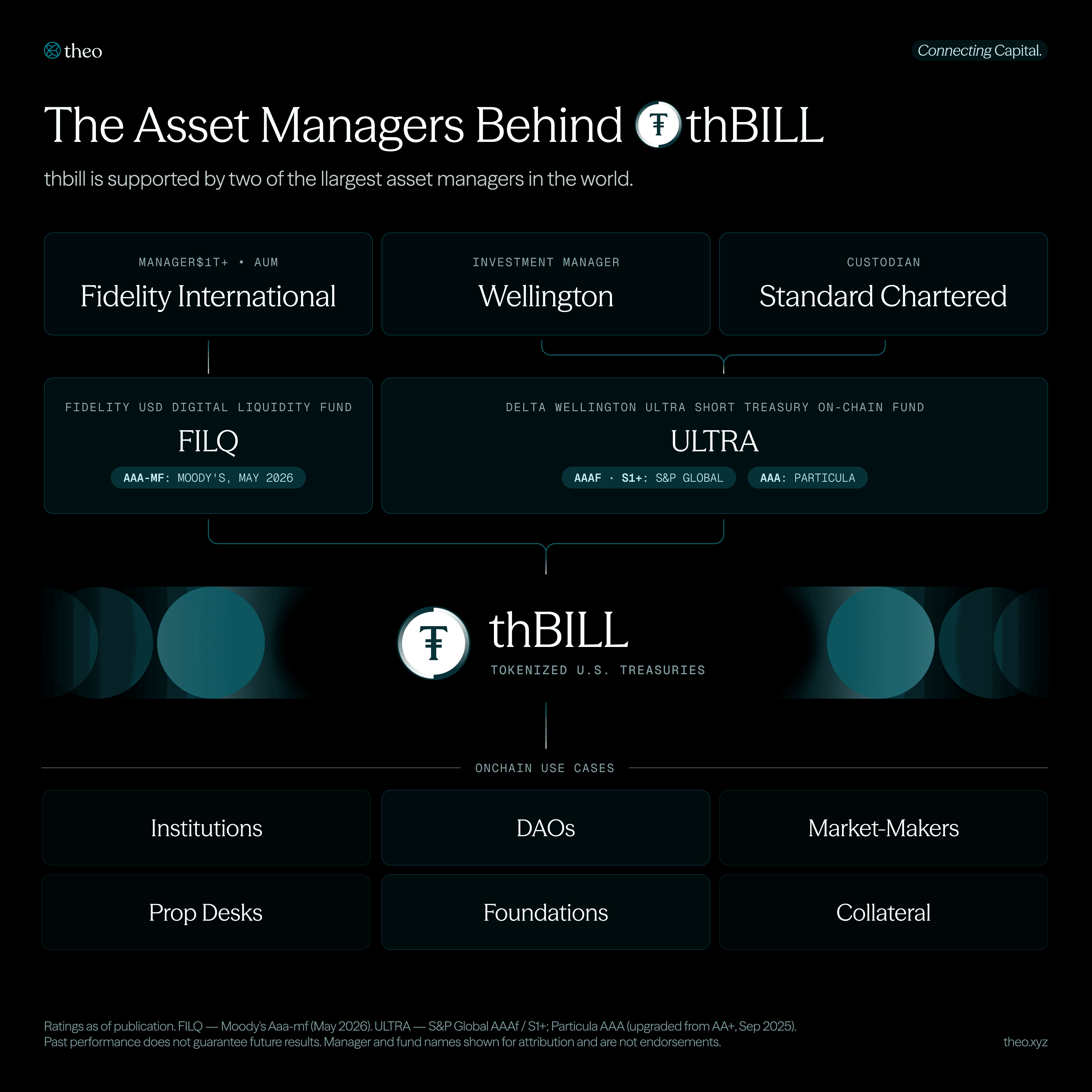
The beauty of this is it elevates thBILL from T-Bill product to onchain cash management primitive. Every onchain treasury, from DAOs to foundations to protocols to market-makers to prop desks, needs somewhere to hold operational cash that earns the risk-free rate, settles instantly, and integrates with the rest of their stack. That's the gap thBILL was built for, and it's the gap institutional buyers recognize, because it's the same gap their offchain treasury teams have been filling with money market funds for decades.
Vision 2: A Foundational Component In The Theo Ecosystem
The second vision is what most of the category isn't competing on. thBILL is not just a standalone product. It is the foundation layer for a connected stack of institutional onchain primitives, each plumbed into a different real market upstream.
thBILL handles the risk-free rate. thGOLD handles structural commodity yield through gold leasing, a market with its own cycle and uncorrelated to crypto and to monetary policy. thUSD combines both into a stablecoin that earns through different regimes because it's drawing yield from mechanisms that don't all move together.
The three products are designed to work together because the markets underneath them don't move together.
Treasury yields move with Fed policy.
Perp funding moves with crypto positioning.
Gold lease rates move with physical commodity demand.
Any single one of these mechanisms compresses under specific stress events, but they don't all compress at the same time.By drawing yield from three uncorrelated sources, the Theo stack is designed to perform across market conditions that would compress any one of them in isolation. That design choice only works because each primitive is plumbed into a real institutional market upstream, not synthesized onchain.
So What Does Fidelity International's FILQ Actually Unlock?
Fidelity International is the moment vision 1 becomes real and the moment vision 2 becomes credible.
A foundation layer is only useful if its foundation is institutionally underwritable. With FILQ, thBILL is now a primitive that an institutional treasury team can actually allocate to, on the same diligence framework they use for offchain money market exposure. That changes what can be built on top of it.
This is what we mean when we say connecting the world's capital. Fidelity International is one milestone, not the last.
Good tokenized treasuries are easy to build. The wrapper, the redemption mechanics, the composability, those are solved problems. What separates good from great is whose name is on the underlying. thBILL has Fidelity International and Wellington.
The rest of the stack is on the same trajectory.