What Is Asset Tokenization? How Real-World Assets Move Onchain
·
7
MINUTES
Tokenization is about removing friction from everything.
Most people hear “tokenization” and picture speculative digital coins. They’re looking at the wrong thing entirely. The real story is settlement speed, 24/7 liquidity, fractional ownership, and the slow death of financial intermediaries: the boring infrastructure changes that actually reshape markets.
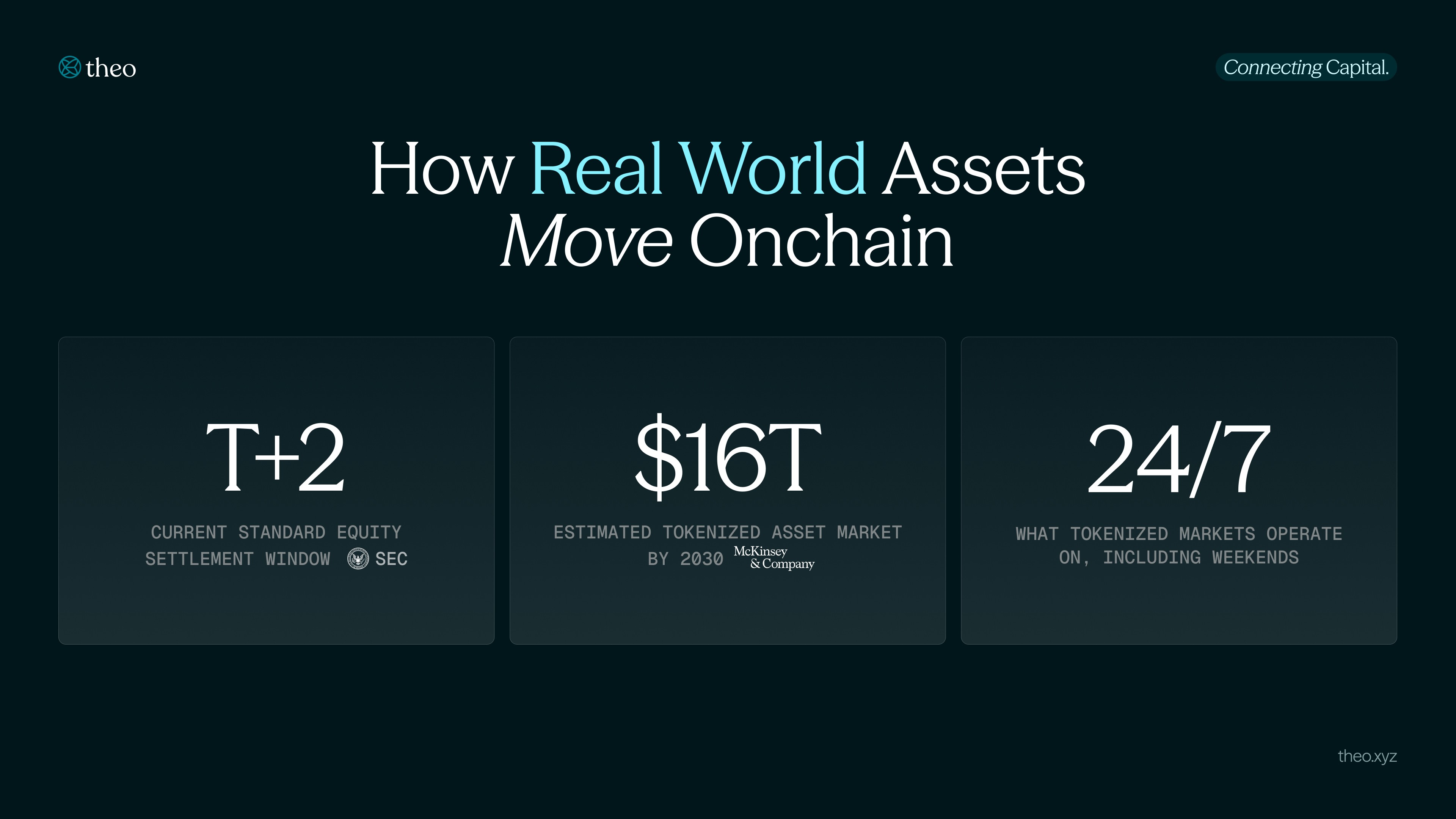
Here is a sentence that sounds unremarkable until you think about it carefully: when you sell a share of stock today, you do not actually receive your money for two business days. Not two seconds or two minutes, but two full days. This is called T+2 settlement, and it is so normal, so completely built into the architecture of modern finance, that most investors have never stopped to ask why.
The answer is: because moving ownership of an asset between two parties requires a chain of custodians, clearinghouses, and counterparty reconciliation systems, a bureaucratic relay race invented before the internet existed and never fundamentally redesigned. Every link in that chain needs time to confirm, record, and guarantee the transaction. The two-day wait is accumulated institutional friction, calcified into standard practice.
This is what asset tokenization is actually about: not coins or speculation or NFT profile pictures, but a bet that the entire settlement and custody infrastructure of global finance can be rebuilt on programmable ledgers, and that when it is, the two-day wait, the intermediary fees, the accreditation walls, and the trading-hours restrictions will look as archaic as fax machines.
So what is asset tokenization, actually?
Asset tokenization is the process of representing ownership rights to a real-world asset (a building, a bond, a fund share, a piece of art, a private equity stake) as a digital token on a blockchain. The token is a programmable record of ownership that lives on a shared, tamper-resistant ledger, distinct from the asset itself.
PLAIN-LANGUAGE DEFINITIONThink of a token as a digital deed. When you buy a tokenized share of a commercial property, you receive a token in a digital wallet that represents your ownership stake. The token records who owns it, when it changed hands, and under what conditions it can be transferred, all automatically, with no registrar required to update a spreadsheet. Unlike a paper deed or a brokerage account entry maintained by a third-party custodian, a blockchain-based token is self-custodial by design: the record of ownership is maintained by the network itself, not by any single institution that could freeze, lose, or misrepresent it.
The underlying mechanics vary; some tokenization projects use public blockchains like Ethereum, others use permissioned enterprise chains operated by consortia of banks. The specific ledger matters less than the structural shift: ownership records that previously lived in siloed institutional databases now live in a shared, interoperable system. That is the change with consequences.
The four problems tokenization actually solves
Problem 1: Settlement Speed
The T+2 settlement window exists because reconciling trades across multiple intermediaries (exchanges, clearing brokers, central securities depositories) takes time. Each institution maintains its own record; synchronizing them requires a sequential handoff process.
On a blockchain, settlement is atomic. When a trade executes, the token moves from one wallet to another in the same transaction. There is no handoff, no reconciliation, no counterparty risk window. Settlement happens in seconds or, in current implementations, in under a minute for more complex transactions. The US equity markets moved from T+3 to T+2 in 2017 and to T+1 in 2024; tokenized markets skip all of that and go straight to near-instant.
For institutional traders, the difference between T+1 and T+0 is not just speed; it is capital efficiency. Every day between trade execution and settlement is a day that capital is locked in limbo, unable to be redeployed. At the scale of global equity markets, that trapped capital represents tens of billions of dollars of opportunity cost.
“The two-day settlement window is accumulated institutional friction, calcified into standard practice, and tokenization is the first credible proposal to dissolve it.”
Problem 2: Liquidity, or the Lack of It
A $50 million commercial real estate building is, on paper, a valuable asset. In practice, it is almost perfectly illiquid. Selling it requires finding a willing buyer, negotiating a price, engaging lawyers on both sides, conducting due diligence, and waiting months for closing. There is no exchange, no bid-ask spread, no way to sell a fraction of the building if you need $200,000 in cash by Thursday.
This is not unique to real estate. Private equity, infrastructure assets, fine art, venture capital fund stakes, litigation finance positions: enormous pools of wealth sit in assets that trade rarely, opaquely, and exclusively among large institutions with the patience and resources to operate in private markets.
Tokenization does not automatically make illiquid assets liquid. But it creates the infrastructure for secondary markets to exist. If ownership of a building can be divided into tokens that trade on a digital exchange, then a limited partner who needs liquidity does not have to wait for a fund redemption window or find a buyer for their entire stake. They can sell tokens. Not the whole asset, just a slice of it. That changes the investment calculus for every asset class that has historically been inaccessible because of its illiquidity premium.
The more sophisticated builders in this space have recognized a harder lesson: issuing the token is only half the job. A tokenized asset with no secondary market, no accepted collateral framework, and no integration into trading venues is functionally inert, a better certificate of ownership but not yet a better financial instrument. A small number of platforms are now treating liquidity as a design requirement from day one rather than something that develops organically after launch. Theo, built by former market makers from IMC Trading and Optiver, launched thBILL (an onchain exposure to institutional US Treasury strategies managed by Wellington Management, in partnership with Standard Chartered’s Libeara) with integrated market making, lending protocol support, and multi-chain deployment built into the product from launch across Ethereum, Base, Arbitrum, and HyperEVM. The token can be traded, posted as collateral, or put to work in DeFi protocols without conversion. It is a live demonstration of what the liquidity problem actually requires: not just issuance infrastructure, but the full market structure that makes a tokenized asset worth holding.
Problem 3: Fractional Ownership and the Access Wall
The minimum investment in most private credit funds is $500,000. The minimum for many commercial real estate syndications is $100,000. These floors exist not because smaller investors would make the economics worse, but because administering a large number of small investor relationships is expensive: tracking ownership, processing distributions, handling redemptions. The paperwork cost per investor does not scale down the way the investment does.
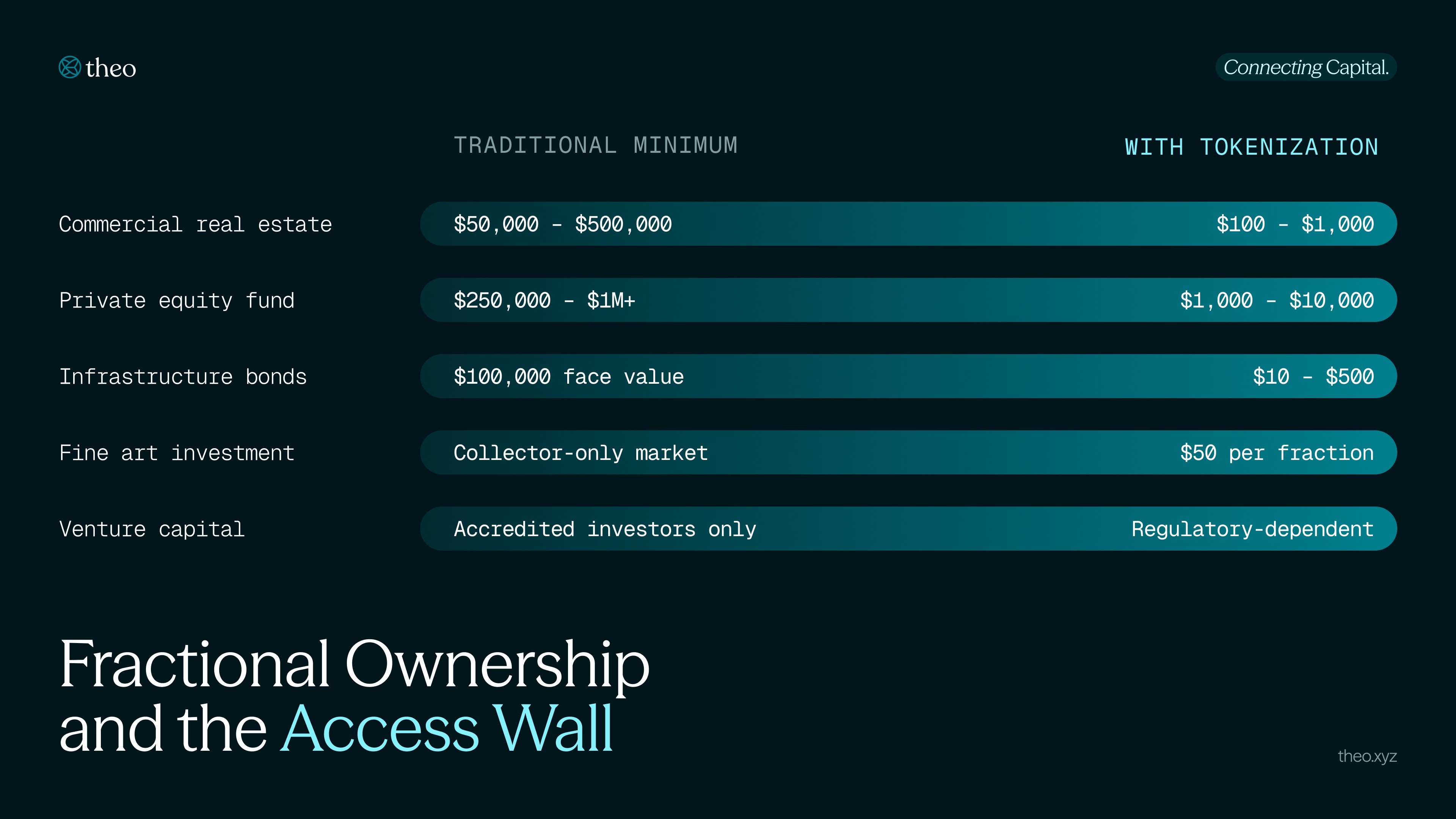
Smart contracts eliminate most of that administrative overhead. Dividend distributions can be programmed to execute automatically when a condition is met, with no manual processing and no custodian fee. Ownership records update in real time. Investor communications can be delivered on-chain. The per-investor administrative cost approaches zero, which means minimum investment floors can drop orders of magnitude without destroying fund economics.
The regulatory picture here is genuinely complicated: securities laws in most jurisdictions still require accreditation for certain investments, and tokenization does not change those rules. What it changes is the economic feasibility of serving a broader investor base once regulations permit it, or in the growing category of assets where they already do.
Problem 4: Removing Intermediaries (The Actual Mechanism)
Every intermediary in a financial transaction exists to solve a trust problem. The escrow agent ensures neither party absconds with the money during a property closing. The clearinghouse guarantees that if your counterparty defaults, you still receive your securities. The custodian holds assets on behalf of clients who cannot be trusted to self-custody safely.
Smart contracts replace trust with code. A tokenized bond can be programmed to automatically transfer coupon payments to token holders on specified dates, release collateral when a loan is repaid, and execute early redemption if certain conditions are triggered, all without a trustee, a paying agent, or an indenture administrator. The contract terms are enforced by the network, not by any institution that could be corrupted, bankrupted, or simply negligent.
1. Asset is represented as a token
Legal ownership rights are encoded into a smart contract on a blockchain, with the token serving as the transferable representation of those rights.
2. Terms are programmed into the contract
Payment schedules, transfer restrictions, redemption conditions, and governance rights are embedded in code, self-executing without human intermediaries.
3. Tokens trade on secondary markets
Token holders can sell their position on exchanges built for tokenized assets, with settlement occurring in seconds and without a clearing intermediary.
4. Cash flows distribute automatically
Rental income, coupon payments, and other distributions go directly to token holders’ wallets when triggered, with no paying agent, no float, and no processing delay.
Why This Is Not a Crypto Story
The conflation of tokenization with cryptocurrency speculation is understandable and almost entirely unhelpful. Yes, tokenization uses blockchain technology. Yes, the same ledger infrastructure underlies Bitcoin. But the comparison ends there.
Bitcoin and its speculative derivatives are assets whose value derives from scarcity and narrative. Tokenized real estate, bonds, and private equity are representations of assets whose value derives from income, cash flow, and tangible operations. Tokenization is a new ownership and settlement layer for existing asset classes.
The institutions building tokenization infrastructure are JPMorgan, BlackRock, Franklin Templeton, Goldman Sachs, and HSBC, institutions whose entire business model depends on managing real assets for real clients. JPMorgan’s Onyx platform has processed hundreds of billions in tokenized repo transactions. BlackRock’s BUIDL fund, a tokenized money market fund, crossed $500 million in assets within weeks of launch. These are infrastructure investments in a faster, cheaper settlement layer.
“The institutions building tokenization infrastructure are firms like BlackRock, Franklin Templeton, and JPMorgan, companies whose survival depends on managing real assets reliably.”
The Honest Obstacles
It would be dishonest to present tokenization as simply inevitable. There are structural obstacles that will slow adoption in ways that have nothing to do with the technology.
Legal frameworks in most jurisdictions still define asset ownership in terms of paper records, registered agents, and custodial accounts. A token on a blockchain has no automatic legal standing; it requires explicit regulatory recognition, which varies enormously by country and asset class.
Some governments are moving. The EU’s DLT Pilot Regime and the UK’s Property (Digital Assets etc) Bill are early examples. But legal certainty for tokenized assets remains patchwork.
Interoperability between different blockchain platforms is another unsolved problem. A tokenized bond issued on JPMorgan’s Onyx chain cannot automatically settle against a tokenized fund share issued on Ethereum without a bridge, which reintroduces counterparty risk of a different kind. The proliferation of competing settlement networks is, ironically, recreating the siloed institutional database problem that tokenization was supposed to solve.
Then there is the question of incentives. The intermediaries being displaced are not passive bystanders. Custodians, clearinghouses, and transfer agents represent significant fee income for the institutions simultaneously trying to build tokenization platforms. The incumbents have every incentive to adopt the technology slowly and in ways that preserve their existing revenue streams.
What Changes, and What Does Not
The honest summary of where tokenization leads is not a utopia of frictionless markets. Settlement risk does not disappear; it migrates from counterparty credit risk to smart contract code risk, which has its own vulnerabilities. Fractional ownership does not automatically create deep liquidity: a thousand small investors in a tokenized building still cannot force a sale, and the market for the tokens will be thin unless market makers participate actively.
What Changes is The Cost Structure of The Plumbing.
The T+2 window shrinks toward zero. The minimum viable investment in illiquid asset classes falls. The per-transaction cost of processing a payment or recording an ownership transfer approaches the cost of a database write rather than the cost of a human-operated administrative process. None of these changes are dramatic in isolation. Compounded across the full range of assets currently locked in slow, expensive, intermediated structures, they represent the largest rewiring of financial infrastructure since electronic trading replaced open outcry.
The story is infrastructure. The investment thesis, the regulatory questions, and the timeline are entirely different depending on whether you understand that, and most people tracking tokenization still do not.